
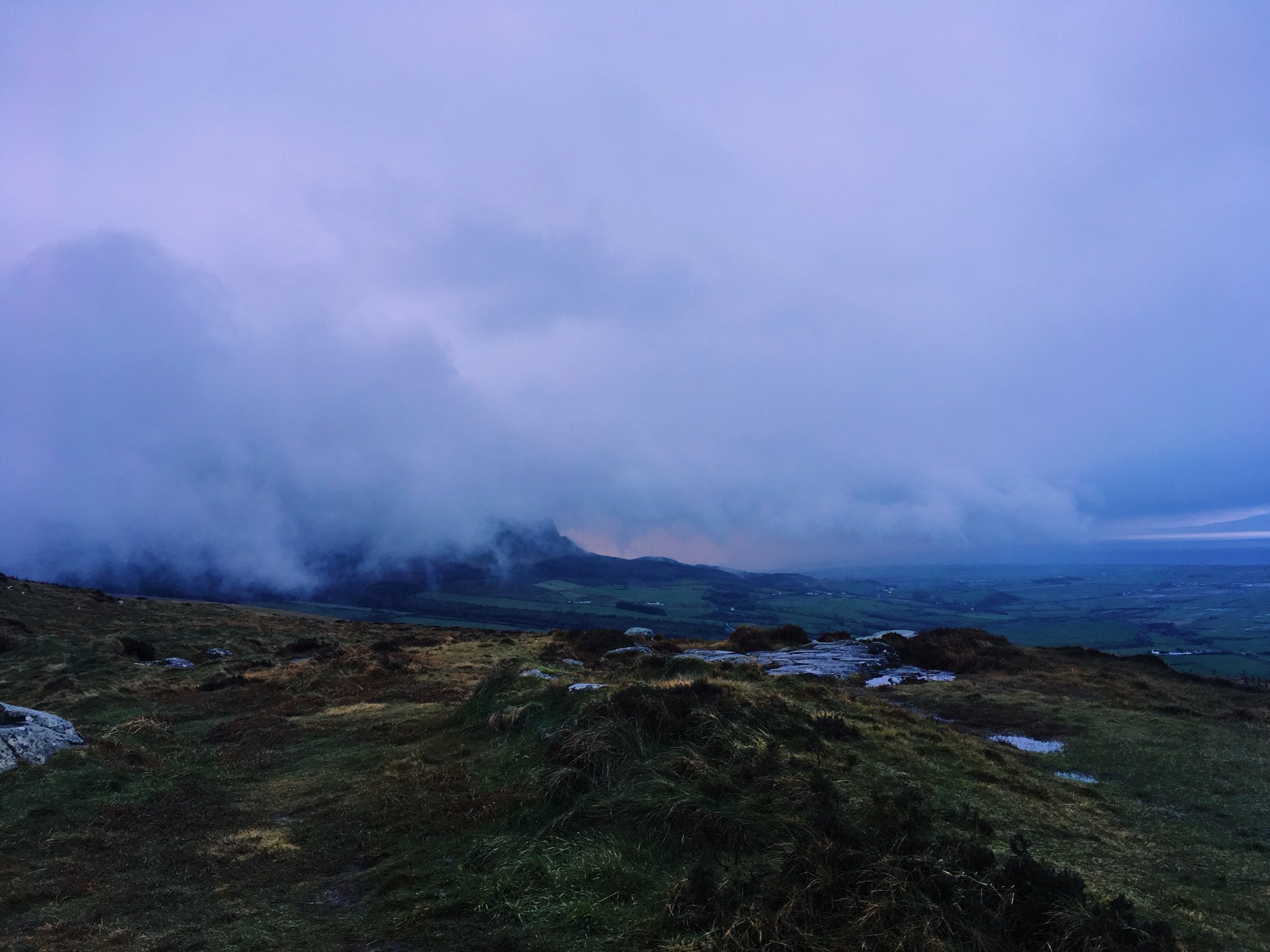
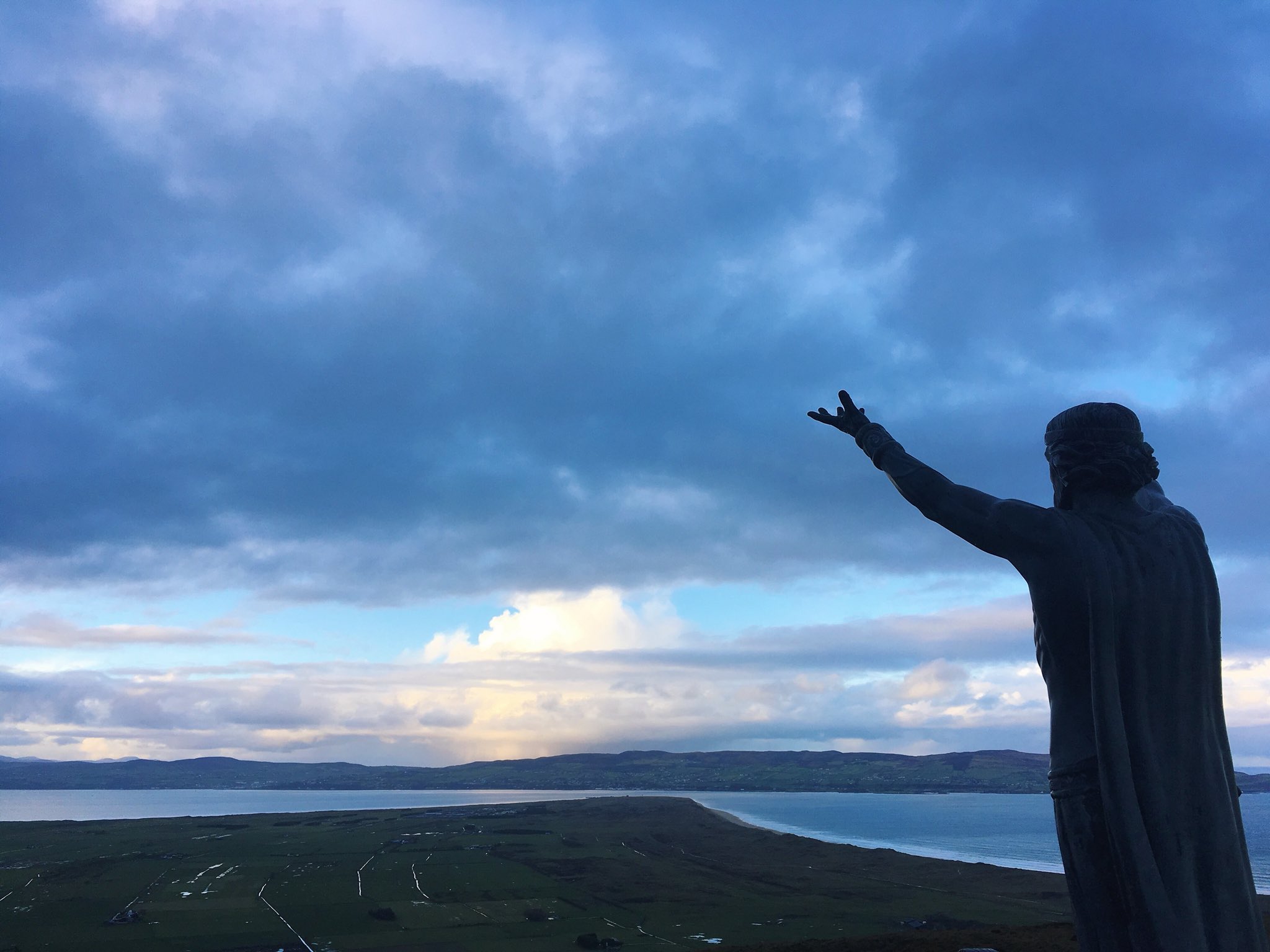
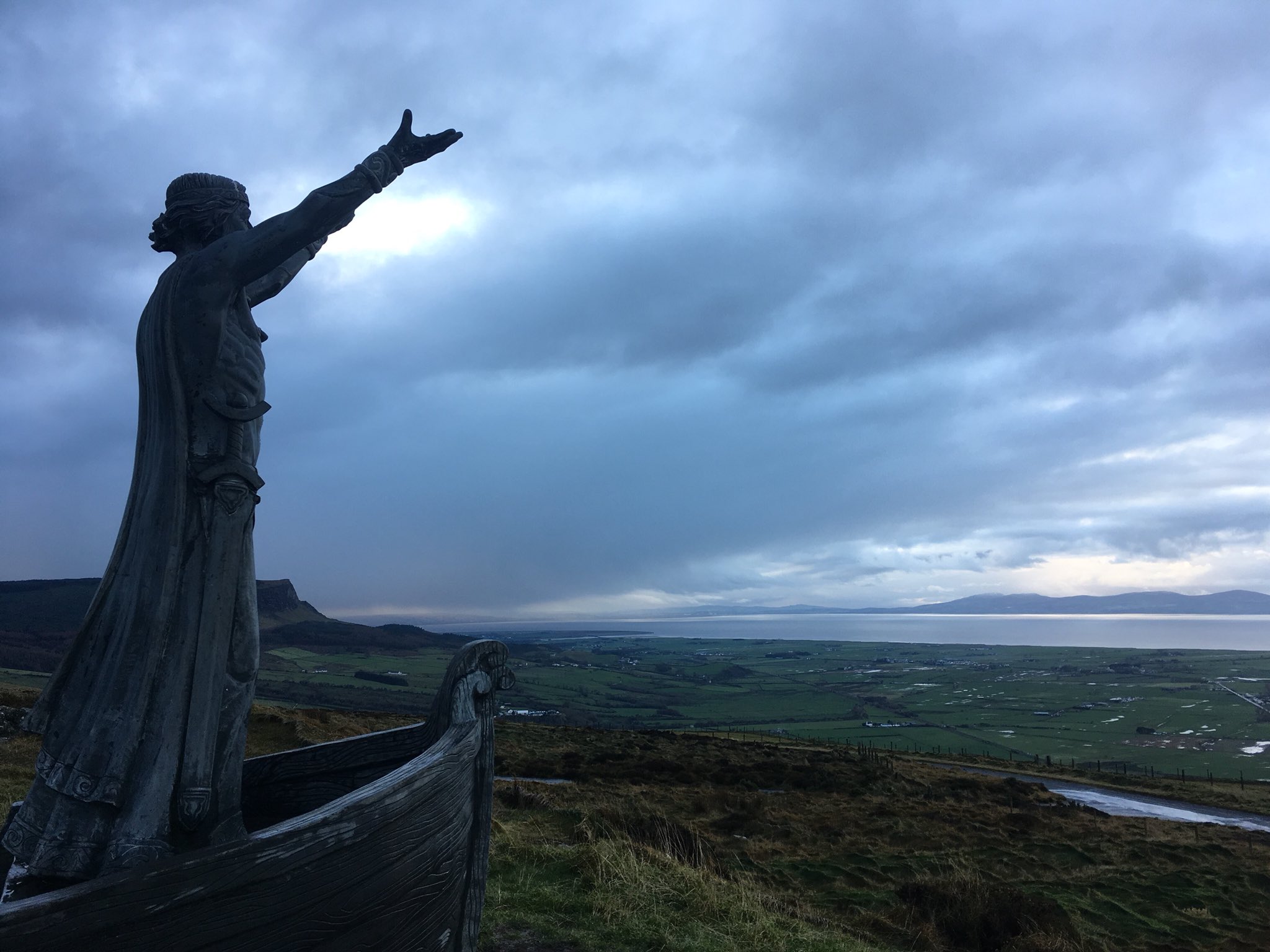
Along the north coast of Northern Ireland, just a few miles outside the town of Limavady, is Gortmore viewpoint. From it, you can feel like the whole world is at your feet, stretching out for miles and miles before you. Loch Foyle is the gem of this view: it sweeps across the landscape and pours into the sea, over which – on a clear day – you can see some islands off the coast of Scotland.
I was lucky to grow up around such a place. But, completely unknown to me when living there was the vast amount of literature written in the medieval period about Loch Foyle and the surrounding area. I hadn’t a clue about this rich corpus until I came to university, and began studying the history and literature of medieval Ireland. Ironically, it was only in England I had the opportunity to learn the Irish language.
One of the earliest texts I read was Immram Brain meic Febail – or, The Voyage of Bran, son of Febal. In it, a figure named Bran embarks on a sea-voyage to the Tír na mBan (‘Land of Women’), at the behest of a mysterious woman who appears one day in his court. During his journey, Bran encounters a man riding across the sea in a chariot towards him. This man, called Manannán mac Lir (Manannán, son of Ler, or son of the sea), is possibly an echo of one of Ireland’s pre-Christian deities. At the very least, the Christian writer(s) of Immram Brain thought he was once such a god. Manannán sings twenty-eight quatrains to Bran about how he possesses a kind of double-sight: Manannán sees a meadow of flowers, whereas Bran sees the ocean. Then Manannán goes on to predict the coming of Christ, and the birth of his own son, Mongán (who was the subject of another Irish saga, Compert Mongáin, The Conception of Mongán). Finally, he declares that Bran’s journey would be over by sundown. Bran wordlessly moves on from this encounter, and eventually reaches the Tír na mBan. After spending years there, which apparently only feels like the passing of only a few days, Bran returns home with his men. When they arrive back, they find out no-one knows Bran’s name – except from an old story, called the Immram Brain. Bran then dictates his travels to this host of people, then departs once more with his men. The last sentence of the story is thus: ‘Ocus ní fessa a imthechta ónd úair sin’, ‘And his voyages from that hour forth are not known.’
Manannán is a focal point for the Gortmore viewing point, where a statue of him raises his hands over the stunning views of the Loch below. But you wouldn’t think Immram Brain had survived the ravages of time by looking at the information sign near the statue. It proclaims Manannán was the ‘Irish Neptune’, and talks mostly about the Broighter gold hoard found in the Loch and how it might have been an offering to such a sea god. While both are important – Manannán’s depiction in Immram Brain is almost certainly based on Neptune riding over the sea at the beginning of the Aeneid, and the Broighter gold is an incredible archaeological discovery – it’s a shame that Immram Brain isn’t mentioned at all. Manannán’s appearance in this text is the earliest recorded mention of him in Irish literature.
It feels like this exclusion stems from two reasons. Firstly, there is the barrier of the Irish language, especially between Old and Middle Irish and modern audiences. The fact that these forms of the language are almost exclusively taught in academic circles, and that translations of texts written in them are hardly ever produced, stops the general public from finding out about them. Then, it seems there’s an almost unspoken desire to ignore even more of Ireland’s past in order to preserve a sense of mystery and mystique: to dwell upon a ‘lost’ ancient history, when the thoughts and words of medieval authors are right here, waiting to be read. To me, at least, what survives is just as intriguing.
As part of this feeling – and to help myself practice reading Old Irish – I wanted to write my own translation of the first eleven stanzas of Manannán’s song. I’ve never felt very confident writing even about poetry, never mind composing poetry of my own: so this is as much a completely new experiment as anything else.
To give myself the most manoeuvring room as possible, I wanted to use mostly free verse, with some small constraints. First of all, I decided to keep the AABB rhyming scheme used in the original Old Irish. I also deliberately decided to use a lot of alliteration, aligning as much as I could with where it occurs in the original. Alliteration is one of the most favoured techniques of Irish writers, both in prose and poetry, and it felt right to reflect that.
I have tried, within these two constraints, to keep to the original meaning of the Old Irish. Sometimes that has meant not going for a word-for-word translation: I feel like Kuno Meyer’s edition has done an excellent job of that already. Instead, sometimes I tried to evoke the whole meaning or sense of a line; sometimes I tried instead to convey the contrast made between two couplets. Hopefully, whatever I’ve produced out of all of this is somewhat readable, but also gets some sense of the lilt and movement of the original Irish: like a currach bobbing along the waves of the sea.
I used the Irish edition of the text from Kuno Meyer, and Alfred Trübner Nutt, The Voyage of Bran, Son of Febal, to the Land of the Living: An Old Irish Saga. (London, 1895), 17-21: it also contains a more literal translation of the text as a whole. You can find a copy freely available here, or read it embedded below.
Manannán’s Song
1. In Bran’s eyes, a beautiful sight,
in his currach, across the sea so light;
While mine see, on my chariot afloat,
a meadow through which he steers his boat.
2. Clear-bright water around the hull,
seen from the prow of Bran’s scull.
A bloom-bursting bawn to me revealed,
stood on my chariot, double-wheeled.
3. Bran views –
countless waves, amid clear ocean hues.
Well, as for me, it’s the Mag Mon,1
with faultless, flamed flowers thereupon.
4. Foam-tressed horses in summer shimmer,
as far as Bran’s gaze across the ocean glimmer.
From blooming flowers rich honey seeps,
growing across lands which Mannanán sweeps.
5. You, amid the sun-glitter of open sea,
you, rowing through foam and debris;
here, it is gilded, ocean-green grass,
it is solid, unyielding, smooth and fast.
6. From the bowels of breakers salmon leap,
from white-crest waves upon your eyes keep.
Flecked scales are Friesans; rainbow hues, lambs’ pelage,
all gentle, here, without hint of the deluge.
7. Ah, you see but one horseman and car:
flower-flooded Mag Mell2 is thus far
across its surface soaked with such steeds,
though unable are you to see where they speed.
8. Great is this grassland, loaded with life,
colours are gleaming, with full-splendour rife.
A stream of silver, a cloth of gold,
beaming are all, a perfect welcome to behold.
9. A charming game – a sight most lovely –
at which they sit, with wine a luxury.
Beneath dappled leaves, man and lady,
without knowing evil, without malady.
10. Midst treetop leaves your coracle sails,
then over furrow and ditch it trails.
Past the mast-mottled forest does slip
the neat little prow of your ship.
11. It brushes aside both blossom and haw,
churns up their sweet scent, without flaw.
A wood in which – unspoiled, undecayed –
leaves with gold dew-drops are displayed.
- ‘Mag Mon’ could be translated as the ‘Plain of Feats’, ‘Tricks’ or ‘Accomplishments’.
- ‘Mag Mel’ means literally the ‘Pleasant Plain’.
 jenyth evans